
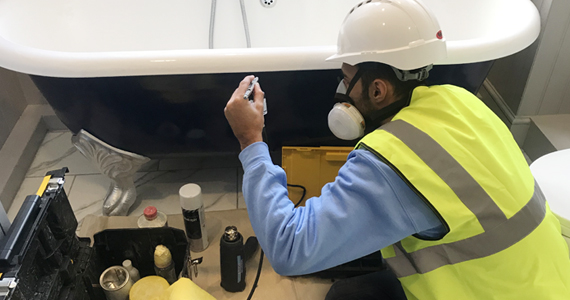


When your bathtub is damaged in Scotland's largest city, bath repair Glasgow from Surface Doctor provides the perfect solution without the disruption of full replacement. From the grand Victorian tenements lining Byres Road and Hyndland Road in the West End to the red sandstone terraces of Shawlands and Strathbungo on the Southside, Glasgow's iconic architecture demands specialist bathroom care. Whether you're restoring an original cast iron bath in a Hillhead close or fixing chips in a modern apartment at Glasgow Harbour, professional restoration saves time, money, and your property's character.
Glasgow is a city defined by its tenements. Around 73% of Glaswegians live in flats – a figure far higher than comparable English cities – and the vast majority of those flats are in the sandstone tenement blocks built between 1850 and 1915 that line streets from Partick to Parkhead, Maryhill to Mount Florida. These buildings, never taller than the width of the street, were constructed from locally quarried blonde sandstone from Bishopbriggs and Giffnock or rich red sandstone from Dumfriesshire. Their shared closes, bay windows, and high-ceilinged rooms are the fabric of Glasgow life. And every one of them has a bathroom with a bath that will eventually need repair.
Glasgow's water is famously soft. Drawn from Loch Katrine in the Trossachs, 35 miles north of the city, and carried by gravity through Victorian aqueducts to Mugdock Reservoir near Milngavie, it contains almost no dissolved minerals. That's excellent for making tea and kind to your skin – but soft water has a slightly higher acidity that gradually etches enamel and porcelain surfaces over decades. Baths in Glasgow homes don't suffer the limescale crusting you see in London or the south-east, but they do develop a slow, even dulling of the enamel surface that eventually exposes the substrate beneath. Our bath repair Glasgow materials are specifically formulated for this soft water chemistry, creating finishes that resist acidic etching far longer than standard coatings.
Access is the other great Glasgow challenge. The typical tenement close leads to a stone stairwell serving two flats per landing across three or four storeys. The stairs are narrow, the turns are tight, and the landings are shared. Removing a cast iron bath – many of which weigh 150-250kg – from a third-floor flat on Novar Drive in Hyndland or a top-floor flat on Battlefield Road in Mount Florida is an exercise in impossibility. The bath simply cannot fit down the stairs. Even if it could, the disruption to neighbours, the risk of damage to the decorative tile closes and stone steps, and the weeks of plumbing work required make replacement absurd when professional in-situ repair achieves a result that lasts 10-15 years.
Glasgow's property market adds further context. The same tenement flat design that sells for £350,000 in Hyndland might cost £60,000 in Haghill. But the bath repair challenge is identical – the same sandstone building, the same stair access, the same cast iron bath. What differs is the financial logic. In the West End, preservation of original features is paramount. On the East Side, cost-effective maintenance matters most. Bath repair Glasgow serves both needs equally well.
A bath repair in a Glasgow tenement is a specialist job. You need a technician who can carry equipment up narrow stone stairs, protect a shared close with decorative tiles, work in a bathroom that may be smaller than a modern shower room, match colours on enamel that's been subtly altered by 100 years of Glasgow's soft water, and complete the job without disrupting the neighbour whose front door is three feet away. That's what Surface Doctor provides – and that's why we've completed thousands of bath repairs across Glasgow's G postcodes.

The most common bath repair Glasgow request. A dropped bottle in a Partick tenement, a stress crack in a Dennistoun flat, impact damage in a Shawlands bathroom – we handle them all using advanced composite materials colour-matched to your existing bath. Our technicians carry extensive colour libraries including the distinctive cream and off-white shades typical of original Edwardian enamel found throughout Hyndland and Pollokshields. Chip repairs start from £150; crack repairs from £245.
When surface damage or age-related dulling is too widespread for spot repair, full resurfacing transforms the entire bath without removal. Using professional spray equipment in fully contained conditions, we apply primer and topcoat systems formulated specifically for Glasgow's soft water chemistry. The slightly acidic Loch Katrine water that slowly etches standard enamel is no match for our specialist coatings. This works equally well on a Victorian claw-foot tub on Crown Road North and a modern acrylic bath in a Finnieston apartment. Full resurfacing costs £350-£495 and takes 3-4 hours.
Glasgow's tenements contain one of the highest concentrations of original cast iron baths in Britain. The grand West End flats along Great Western Road, Hyndland Road, Novar Drive, and Cleveden Road feature Victorian and Edwardian baths that are integral to these properties' character and value. Similarly, Alexander “Greek” Thomson's classical tenements on Walmer Crescent in Ibrox and Nithsdale Road in Strathbungo contain original fittings worth preserving. Our re-enamelling process removes damaged enamel, treats corrosion, and applies a new vitreous enamel-effect coating replicating the original depth and lustre. Costs range from £385-£545.
Glasgow's tenement closes are our working environment every single day. From the ornate “wally closes” of Hyndland – with their decorative ceramic tiles, stained glass windows, and iron balustrades – to the simpler shared stairs of Dennistoun, Maryhill, and Govanhill, we've perfected techniques for working in these buildings without causing damage. Our equipment breaks down for single-person carry. All materials are mixed on-site in your bathroom. We protect communal areas with heavy-duty coverings and coordinate with factors and neighbours. We've repaired baths in tenements across every Glasgow postcode – from the four-storey mansion flats of Clarence Drive to the compact two-storey blocks of Springburn.
Glasgow's West End became the city's first Conservation Area in 1972, and Hyndland has its own unique conservation designation – the only one of its kind in the UK. Additional conservation areas cover Pollokshields, Strathbungo, Dennistoun's Craigpark, and parts of Crosshill. Our bath repair techniques are completely reversible and non-invasive, meeting all conservation requirements. We regularly work in Category A and B listed properties including grand townhouses on Park Circus, Woodlands Terrace, and Buckingham Terrace.
Glasgow's post-war housing estates – Knightswood, Cardonald, Castlemilk, Drumchapel, Easterhouse, and Pollok – contain thousands of properties with original 1960s-1980s coloured bathroom suites. Avocado green, champagne, burgundy, and pampas were all popular across Glasgow's council and ex-council housing stock. We can match any colour for invisible repairs or, more commonly, resurface to contemporary white in a single 4-hour appointment. This colour change transforms a dated bathroom without touching tiles, pipework, or flooring – saving thousands compared to a full refit.

A young couple had purchased a top-floor flat in a blonde sandstone tenement on Hyndland Road. The property had beautiful original features – cornicing, a tiled fireplace, stripped pine floors – but the original Edwardian cast iron bath was badly stained with a network of hairline cracks in the enamel.
The Problem: Three bathroom fitters quoted £6,500-£9,000 for a full bathroom refit, which was the only way to replace the bath – it physically couldn't fit down the close stairs. One fitter suggested breaking it up with a sledgehammer, removing it in pieces, and fitting a modern acrylic bath. But destroying an original Edwardian feature in a Hyndland conservation area flat felt wrong, and would have reduced the property's value.
Our Solution: Full cast iron re-enamelling completed in a single day. We treated the rust spots beneath the cracked enamel, then applied a new finish matching the original warm cream tone. Total cost: £485.
Result: The bath looks and feels like new. The original Edwardian feature is preserved. The couple saved over £6,000 and avoided weeks of disruption in a building where they share a close with five other households.
Mr. and Mrs. Henderson on the second floor of a red sandstone tenement on Minard Road woke to find a 15cm crack running along the base of their cast iron bath. Water was dripping through the kitchen ceiling of the ground-floor flat below. The downstairs neighbour was threatening insurance action.
The Problem: A plumber confirmed the bath was leaking and estimated 3-4 weeks for replacement including new plumbing, floor repair, and retiling. In the meantime, the family – including two young children – would have no bath. The factor was demanding immediate action to prevent further damage to the common building.
Our Solution: Emergency same-day callout. We arrived within 90 minutes. The crack was reinforced with aerospace-grade composite, sealed, and refinished in a colour-matched enamel. Total time on-site: 3.5 hours. Cost: £345.
Result: Leak stopped immediately. Bath back in use within 24 hours. The downstairs ceiling damage was minor and covered by building insurance. Eighteen months later, the repair remains watertight with no visible trace of the original crack.
A landlord operating six HMO properties in the Hillhead and Woodlands area near Glasgow University needed bath maintenance across all properties before the September student intake. Years of heavy use had left multiple chips, stains, and worn anti-slip surfaces.
The Problem: Replacing 6 baths across tenement flats would cost over £30,000 and couldn't be completed in the 3-week void period between tenancies. The landlord also needed to maintain HMO licence compliance, which requires documented maintenance.
Our Solution: All 6 baths repaired across 4 working days. Each received chip repair, targeted resurfacing, fresh anti-slip treatment, and professional cleaning. We provided HMO-compliant maintenance documentation for each property. Total cost for all 6: £1,980.
Result: All properties ready for students 2 weeks ahead of schedule. Saving of over £28,000 versus replacement. The landlord now schedules annual maintenance every August as standard. HMO inspector confirmed compliance at next review.
The owner of a beautifully restored flat in one of Alexander “Greek” Thomson's tenements on Nithsdale Road had fitted a reclaimed Victorian roll-top bath as the centrepiece of her bathroom renovation. After installation, she discovered a deep chip on the interior rim and a patch of pitted enamel on the base that the seller hadn't disclosed.
The Problem: The bath was a specific design she'd searched months to find. Returning it wasn't an option – it had already been plumbed in. A replacement of similar quality would cost £2,000+ and require disconnection, removal down a close stairwell, reinstallation, and replumbing.
Our Solution: On-site repair of the chip using colour-matched composite, followed by localised resurfacing of the pitted area. The entire bath was then sealed with a protective topcoat. Time on-site: 2.5 hours. Cost: £295.
Result: The damage is completely invisible. The bath looks exactly as the owner envisioned when she purchased it. She saved over £2,500 in replacement costs and avoided disrupting her newly completed bathroom.
A retired gentleman in a 1950s semi-detached on Alderman Road in Knightswood wanted to modernise his bathroom without the stress of a full renovation. The original champagne-coloured bath was structurally sound but dated-looking, with several chips and general surface wear from 40+ years of daily use.
Our Solution: Full bath resurfacing from champagne to brilliant white, including repair of 4 chips and a hairline scratch. The surrounding champagne tiles were left untouched – the white bath actually creates an attractive contrast. Completed in a single 4-hour appointment. Cost: £445.
Result: A completely refreshed bathroom appearance without any building work, dust, or disruption. The homeowner estimated a full bathroom refit would have cost £7,000-£10,000 and taken two weeks. He was using his “new” bath within 24 hours.
Glasgow's West End is the city's most sought-after residential area and home to its finest tenement stock. The streets radiating from Byres Road – Hyndland Road, Novar Drive, Clarence Drive, Queensborough Gardens, Crown Road North, Cleveden Road, and Highburgh Road – contain grand three and four-storey blonde sandstone tenements built from the 1880s to 1910s. Many feature ornate wally closes with decorative ceramic tiles, stained glass stairwell windows, and original bathroom fittings. Hillhead, Dowanhill, and Kelvinbridge along Great Western Road, Southpark Avenue, and Bank Street contain similar period properties popular with university staff and professionals. Bath repair Glasgow in the West End is primarily about preserving irreplaceable original features in conservation area properties where quality and authenticity matter.
Glasgow's Southside rivals the West End for architectural quality. Shawlands, along Kilmarnock Road, Minard Road, and Tantallon Road, features substantial red sandstone tenements built in the 1890s-1900s. Strathbungo, along Nithsdale Road, Darnley Street, and Regent Park Square, is a conservation area containing Alexander Thomson's classical tenements with their distinctive pilasters and carved sandstone. Pollokshields, across Albert Drive, St Andrew's Drive, Leslie Road, and Terregles Avenue, features some of Glasgow's grandest tenement flats with parlours, dining rooms, and multiple bedrooms. Queen's Park and Langside, along Queen's Drive, Battlefield Road, and Langside Avenue, complete the Southside's impressive tenement stock. Bath repair Glasgow on the Southside serves a diverse community in buildings that range from modest two-room flats to enormous five-apartment homes.
Dennistoun, Glasgow's “up and coming” neighbourhood, sits east of the city centre around Alexandra Parade, Hillfoot Street, Craigpark, and Whitehill Street. Its tenements match the West End architecturally but at a fraction of the price, attracting young buyers and investors. The Craigpark area is a designated conservation area. Further east, Parkhead along Westmuir Street, Shettleston along Shettleston Road, and Tollcross along Tollcross Road contain more modest tenement stock where cost-effective bath repair is the priority. Bridgeton and Calton, undergoing regeneration around the Barras and Glasgow Green, present a mix of surviving Victorian tenements and newer housing. Bath repair Glasgow across the East End serves landlords, first-time buyers, and long-term residents equally.
Partick, centred on Dumbarton Road and Byres Road's southern stretch, contains a dense concentration of tenements serving Glasgow's student and young professional population. Whiteinch along Victoria Park Drive South and Scotstoun along Dumbarton Road west feature inter-war tenements and 1930s-1950s housing. Jordanhill, along Crow Road and Southbrae Drive, offers larger inter-war villas and semis. Knightswood, a planned 1920s-1950s estate along Alderman Road, Lincoln Avenue, and Archerhill Road, contains thousands of semis and bungalows with original bathroom fittings now 70-100 years old. Bath repair Glasgow in the north-west covers everything from Victorian tenement cast iron to mid-century coloured suites.
Glasgow's Clydeside regeneration has transformed the waterfront from Finnieston to Pacific Quay. Modern apartments at Glasgow Harbour, along Castlebank Street and Lancefield Quay, and the Clyde Arc developments feature contemporary bathrooms with designer baths that chip and crack like any other. Finnieston itself, along Argyle Street and St Vincent Crescent – Alexander Kirkland's sweeping golden sandstone curve – contains a mix of converted tenements and new-builds. Across the river, Ibrox along Copland Road and Cessnock along Paisley Road West feature traditional tenement stock. Govan, undergoing regeneration along Govan Road near the Riverside Museum, presents its own mix of period and modern properties. Bath repair Glasgow along the Clyde serves both heritage and contemporary needs.
Maryhill, along Maryhill Road and Queen Margaret Drive, contains a substantial stock of Victorian and Edwardian tenements plus inter-war housing. North Kelvinside, along Queen Margaret Drive and Bilsland Drive, borders the West End and shares its architectural quality. Possilpark, Springburn, and Balornock further north feature a mix of surviving traditional tenements and post-war housing. Bishopbriggs (G64), just beyond the city boundary along Kirkintilloch Road, offers suburban villas and semis. Bath repair Glasgow across the north serves diverse housing stock from ornate Victorian tenements to straightforward 1960s properties where practical, affordable maintenance is the priority.
Chip repairs: £150-£195 (discounts for multiple chips)
Surface scratches & minor wear: £165-£225
Structural crack repair: £245-£385
Full bath resurfacing: £350-£495
Cast iron re-enamelling: £385-£545
Colour change resurfacing: £395-£495
No call-out charges anywhere in Glasgow. Emergency premium: £45-£75. Weekend and evening appointments at standard rates.
Most Glasgow bath repairs complete within 2-4 hours on-site. Chip repairs take 1-2 hours; full resurfacing requires 3-4 hours.
Curing takes 24-48 hours depending on repair type. Glasgow's damp climate can extend curing slightly in winter – we use forced-air drying to maintain schedules when needed.
Compare to full replacement in a Glasgow tenement: £3,000-£9,000 for supply, plumbing, access challenges, and weeks of disruption. Most of our repairs last 10-15 years.
All prices include our comprehensive 12-month warranty covering materials and workmanship.
Glasgow's famously soft water from Loch Katrine is a double-edged sword for bathrooms. On the positive side, you'll never see the limescale crusting common in hard water areas like London or the south-east. But soft water has a slightly higher acidity that gradually etches enamel and porcelain surfaces over decades. This manifests as a slow, even dulling – the bath doesn't look damaged, it just looks tired. Eventually the enamel thins enough to expose the substrate, leading to staining and discolouration that no amount of cleaning will fix. Our repair coatings are formulated specifically for soft water chemistry, with enhanced acid resistance that standard products lack.
We work in Glasgow tenements every single day – from the grand wally closes of Hyndland with their decorative tiles and stained glass to the simpler shared stairs of Govanhill and Springburn. Our equipment breaks down into components one person can carry. We protect communal stairs and closes with heavy-duty coverings, paying particular attention to original tile work. All materials are mixed in your bathroom, not the close. We coordinate with factors and neighbours, and we always leave the common areas exactly as we found them. In 15+ years of Glasgow tenement work, we've never had a single complaint about close damage.
Yes – Glasgow has numerous conservation areas where preserving original features is essential. The West End (designated 1972), Hyndland (uniquely designated), Pollokshields, Strathbungo, Dennistoun's Craigpark, and parts of Crosshill all have conservation protections. Our bath repair techniques are completely reversible and non-invasive – we add to the bath surface rather than removing anything. This makes our work appropriate for listed buildings and conservation properties without requiring consent. We've completed repairs in Category A and B listed buildings across Glasgow including properties on Park Circus, Woodlands Terrace, and Great Western Road.
Absolutely. Glasgow's Clydeside regeneration has produced thousands of modern apartments at Glasgow Harbour, Pacific Quay, Lancefield Quay, Merchant City, and Finnieston. Contemporary acrylic and composite baths chip and crack just as readily as their Victorian cast iron counterparts. Designer baths are often expensive to replace and may be discontinued models. We repair all modern bath types with colour-matched materials and provide the same 12-month warranty. For new-build properties still under developer warranty, our repair often resolves the issue faster than going through the builder's process.
Glasgow's post-war housing estates contain thousands of original coloured suites. Knightswood (G13), Cardonald (G52), Castlemilk (G45), Drumchapel (G15), Easterhouse (G34), Pollok (G53), and Mosspark (G52) all feature properties with 1960s-1980s avocado green, champagne, burgundy, pampas, and primrose yellow bathroom suites. We maintain extensive colour libraries for perfect matching, or – more commonly – we resurface to contemporary white during a single appointment. This colour change transforms a dated bathroom for under £500, compared to £5,000-£10,000 for a full refit. It's the most cost-effective bathroom modernisation available.
Glasgow has a high proportion of HMO (House in Multiple Occupation) properties, particularly around the university areas of Hillhead, Woodlands, and Kelvinbridge (G3/G12). HMO licensing requires landlords to maintain bathroom facilities to specific standards with documented evidence. Our repairs include detailed documentation suitable for HMO inspections, including before-and-after photographs and material specifications. Many Glasgow HMO landlords schedule annual bath maintenance with us as part of their compliance routine. We also work with letting agents and factors across the city who manage portfolios of tenement rental properties.
All Glasgow bath repairs include a comprehensive 12-month warranty covering materials and workmanship. This protects against peeling, discolouration, or failure under normal use. The warranty transfers with property ownership – useful in Glasgow's active property market. Most repairs far exceed the warranty period; we have repairs from 2011 still performing perfectly in properties across the West End and Southside. Warranty claims remain below 2% across all our Glasgow work. Extended warranties are available for commercial properties and landlord portfolios.
For emergencies within Glasgow city, we typically attend within 2-3 hours. A cracked bath leaking into a downstairs flat is the most common emergency we handle – it needs immediate attention to prevent water damage and resolve neighbour disputes. Emergency call-outs carry a modest premium of £45-£75. For same-day non-emergency appointments, we can usually schedule within 24-48 hours across all G postcodes. Our Glasgow team covers the entire city from Milngavie to Castlemilk, Bearsden to Baillieston.

G1: Merchant City, Trongate, High Street, George Square
G2: Blythswood Hill, Bath Street, West Campbell Street
G3: Finnieston, Kelvingrove, Woodlands, Charing Cross, Anderston
G4: Garnethill, Cowcaddens, Port Dundas
G5: Gorbals, Hutchesontown, Oatlands
G11: Partick, Thornwood, Broomhill
G12: Hillhead, Hyndland, Dowanhill, Kelvinside
G13: Jordanhill, Knightswood, Anniesland
G14: Whiteinch, Scotstoun, Yoker
G15: Drumchapel, Blairdardie
G20: Maryhill, North Kelvinside, Firhill
G21: Springburn, Balornock, Robroyston
G22: Possilpark, Lambhill, Milton
G23: Summerston, Cadder
G31: Dennistoun, Haghill, Alexandra Parade
G32: Tollcross, Sandyhills, Mount Vernon
G33: Stepps, Riddrie, Hogganfield
G34: Easterhouse, Barlanark
G40: Bridgeton, Calton, Dalmarnock, Glasgow Green
G41: Shawlands, Strathbungo, Pollokshields, Crosshill
G42: Govanhill, Queen's Park, Mount Florida
G43: Langside, Newlands, Cathcart
G44: King's Park, Croftfoot, Castlemilk
G45: Castlemilk
G46: Giffnock, Thornliebank, Whitecraigs
G51: Ibrox, Cessnock, Govan, Festival Park
G52: Cardonald, Hillington, Mosspark
G53: Pollok, Darnley, South Nitshill
East Dunbartonshire: Bearsden, Milngavie, Bishopbriggs, Kirkintilloch, Lenzie
East Renfrewshire: Newton Mearns, Clarkston, Busby, Eaglesham, Barrhead
South Lanarkshire: Rutherglen, Cambuslang, East Kilbride, Hamilton
Renfrewshire: Paisley, Renfrew, Johnstone, Erskine
West Dunbartonshire: Clydebank, Dumbarton, Old Kilpatrick
Step 1: Call our Glasgow team on 0141 352 2587 or send photos via WhatsApp for an instant assessment
Step 2: Receive a transparent fixed-price quote – no hidden costs, no call-out charges
Step 3: Schedule your appointment (same-day emergency slots available across all G postcodes)
Step 4: Expert technician completes your bath repair in 2-4 hours on-site
Step 5: Enjoy your restored bathtub with our comprehensive 12-month guarantee
Don't let bathtub damage disrupt your Glasgow home any longer. Whether you're preserving an original cast iron bath in a Hyndland wally close, maintaining rental properties across Dennistoun, modernising a 1970s suite in Knightswood, or fixing damage in a Clydeside apartment, our professional bath repair Glasgow service provides the perfect solution. Same-day emergency response, transparent pricing, and a full 12-month guarantee – we make bath restoration simple and stress-free.
Call us now on 0141 352 2587 for immediate assistance, or send photos via WhatsApp for an instant quote. Our Glasgow team covers every G postcode, from the Merchant City to Castlemilk, from Drumchapel to Baillieston. We understand Glasgow's unique challenges – tenement access, conservation area requirements, soft water chemistry, HMO compliance – and have the expertise to deliver outstanding results every time.
Join over 500 satisfied Glasgow customers who chose professional bath repair over costly replacement. Limited slots available this week – contact Surface Doctor now.
