Tell us about your Oxted property — a Victorian or Edwardian slate terrace or semi, a 1930s inter-war house with clay or concrete tile, a post-war or 1960s–80s property, or a property needing storm or tree damage documentation for insurance. Price confirmed from £195 by phone immediately. No forms, no waiting.
Our specialist assesses every element relevant to your property. Victorian slate: nail-sickness assessment across all slopes, lead flashing condition at chimney stacks, ridge and hip mortar. Properties with tree cover: valley gutters and flat roof sections checked for debris accumulation and lead upstand condition. 1930s and later: tile condition, ridge mortar, felt underlay via loft inspection. Storm damage: photographic evidence, cause assessment, repair costing for insurance.
Full written report with photographs, condition ratings, remaining service life estimates, and a prioritised costed action list. Victorian slate: nail-sickness extent and urgency, lead flashing condition, re-slating versus repair verdict. 1930s stock: tile condition and maintenance programme. Storm damage: insurer-ready documentation distinguishing storm from maintenance cause. Report within 48 hours.
Oxted is a commuter town in the Tandridge district of Surrey, sitting at the foot of the North Downs chalk escarpment where the greensand vale meets the rising chalk ridge of Tandridge Hill and the Oxted Downs above. Oxted station provides Southern and Thameslink services to London Bridge and London Victoria, which has driven consistent demand for the town’s Victorian and Edwardian housing stock from London commuters. The RH8 postcode covers Oxted and the adjacent village of Limpsfield. Tandridge District Council is the planning authority.
The oldest and most characterful part of Oxted’s housing stock is the Victorian and Edwardian terraces and semis that line the streets around the town centre, Bluehouse Lane, Granville Road, Chichele Road, and the lanes of Old Oxted. These properties were built between roughly 1880 and 1914, and virtually all carry original Welsh slate roofs. Welsh slate is among the most durable roofing materials available — well-fixed Welsh slate in a sheltered position can last 150 years or more without replacement. At 120 to 140 years old, Oxted’s Victorian slate roofs are not at the end of their material life, but they are at the age where the fixings are the critical assessment question.
The iron or early copper nails used to fix Victorian Welsh slates corrode progressively over decades. As a nail loses section through corrosion, it no longer provides positive fixing — the slate is held by the reduced nail and by the weight of the overlapping slates above. Under wind load, a nail-sick slate will ride up and slide out, typically without warning. The pattern of displacement is not random: slates fixed with the same batch of nails on the same elevation tend to reach failure at similar times, so one displaced slate often signals that several adjacent slates are close to failing. From outside, nail-sick slates look identical to sound ones — the nail is hidden under the overlapping course. Assessment requires close-range inspection and testing individual slates for movement, which cannot be done from the garden or from a scaffold-free ground-level inspection.
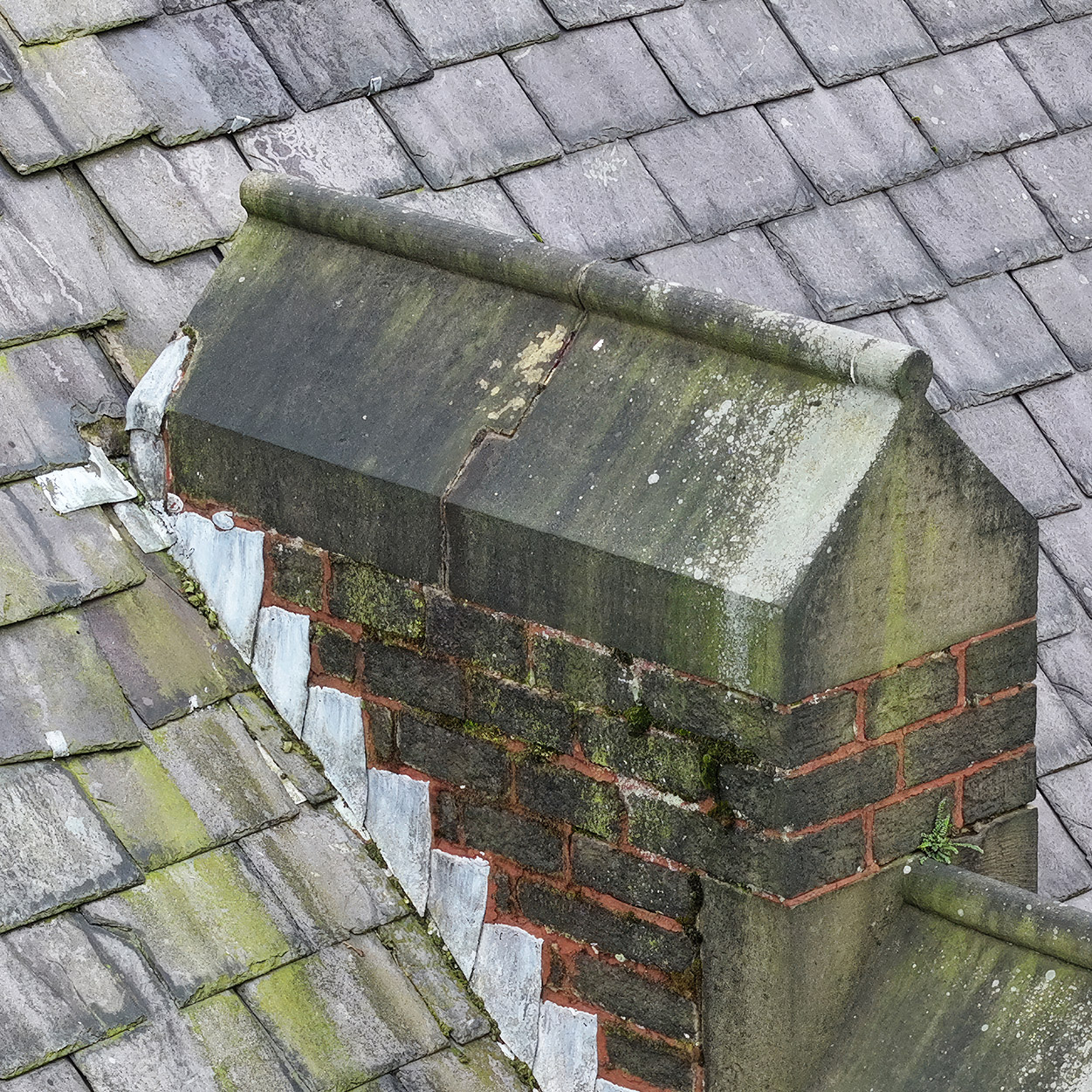
The lead flashings at chimney stacks on Oxted’s Victorian terraces are original to the properties in many cases — 120-year-old lead is typically at or beyond its practical service life. Lead fatigues through repeated thermal expansion and contraction cycles over its life; eventually it develops hairline cracks at points of maximum movement, typically at the upstand-to-mortar joint and at the soaker steps on either side of the chimney. These cracks admit water that appears at the ceiling below the chimney breast — the most common roofing complaint in Oxted’s Victorian stock, and the one most frequently misdiagnosed as a chimney cap or pointing problem when the actual failure is in the lead.
Oxted’s tree canopy is genuinely dense, particularly in the older residential streets. Mature oaks, limes, and chestnuts overhang properties throughout the Victorian and Edwardian streets. This creates two practical maintenance pressures: debris accumulation in valley gutters and against lead flashings at above-average rates, and the storm damage scenario when branches or whole trees fall during high winds. For valley gutter properties, seasonal debris clearance is necessary to prevent compacted organic matter holding moisture against lead upstands and causing crevice corrosion.
The 1930s inter-war housing that expanded Oxted north of the railway — semis and detached houses built in the characteristic Surrey style of the period — carries concrete or clay tile roofs now 85 to 95 years old, with ridge mortar, hip mortar, and chimney flashing assessment as the standard maintenance questions. Post-war and 1960s–80s stock carries concrete tile approaching end-of-life porosity at the older end of the range.
Nearby Areas: Victorian slate and Edwardian property surveys across Caterham and Godstone. North Downs chalk ridge coverage at Warlingham. Limpsfield surveys at Limpsfield. Wider Tandridge District coverage at Lingfield.
Oxted’s Victorian Welsh slate terraces have roofs that are well into their second century. The slates themselves are typically sound — Welsh slate is extraordinarily durable. The fixings are not. Nail-sickness assessment on a 120-year-old slate roof requires close-range inspection and individual slate testing that cannot be replicated from below. Getting that assessment right — establishing whether 10% of slates are at risk or 40% — is the difference between a targeted repair programme and an unnecessary full re-slating quote. We have assessed hundreds of Victorian properties across the Tandridge District and the North Downs commuter belt and provide clear, specific findings.
A first-time buyer made an offer of £525,000 on a Victorian terraced house in central Oxted. The homebuyer survey noted “slate roof in fair condition. Several slates displaced or cracked. Some evidence of torching at eaves. Recommend specialist inspection before exchange.” The buyer commissioned a specialist roof survey before proceeding.
Survey Findings: Nail-sickness assessment confirmed that approximately 35% of the slates on the south-facing front slope had nails at or near failure, with a further 20% on the rear north slope showing early corrosion. The torching visible at the eaves was original lime mortar pointing applied beneath the slates at the eaves course — a Victorian practice that indicates the original fixer knew some of the lower slates had reduced fixing. Seven slates had been replaced with non-matching modern equivalents at various points since the original construction. The lead flashings at the main chimney stack showed fatigue cracking at the upstand on the south face and needed replacement. Ridge mortar on the front slope was at end of service.
Programme and Outcome: Re-slating of the front slope with like-for-like Welsh slate, replacement lead flashings at the chimney, and ridge mortar renewal on the front slope: estimated £7,500–£9,500. Rear slope: nail condition sufficient for 5–7 further years with monitoring. Armed with the report, the buyer renegotiated £8,500 off the purchase price before exchange, reflecting the front-slope programme cost.
Survey cost: from £195. Saving identified through negotiation: £8,500.
After a winter storm, a homeowner on Grange Road noticed slates displaced and some roof decking visible on the rear slope. A large branch from a neighbouring property’s oak had come down across the roof during the storm. Their insurer required “professional assessment” before approving the claim and asked the homeowner to establish whether the damage was storm-caused or pre-existing.
Survey Findings: The survey identified three distinct issues: (1) direct impact damage from the branch — seven slates cracked or displaced in the impact zone, one batten cracked, and the felt underlay punctured across approximately 0.4 square metres; (2) four further slates had been displaced by the storm wind load in areas adjacent to but not in direct contact with the branch, consistent with the recorded wind speed on the night; (3) the remaining rear slope showed early nail-sickness on approximately 15% of slates — this was pre-existing maintenance wear, not storm-caused.
Documentation Outcome: The report separated storm-caused damage (items 1 and 2, totalling approximately 11 slates plus batten and felt) from pre-existing maintenance (item 3). High-quality photographs documented the branch impact point, the displaced slates by category, and the surrounding undamaged areas for comparison. The insurer accepted the claim for storm-related damage immediately. Pre-existing nail-sickness on 15% of the rear slope was correctly noted as a maintenance matter outside the claim scope, and the homeowner was able to plan that separately.
Survey cost: from £195. Insurance claim approved for storm-damage repairs. Pre-existing maintenance identified separately with no claim complications.
Roof surveys for Oxted properties start from £195. Whether a Victorian Welsh slate terrace where nail-sickness extent and lead flashing condition need establishing before exchange or before commissioning repair work; a storm damage scenario where insurer-ready documentation is required to separate impact damage from pre-existing maintenance; or a 1930s or later property where the re-roof vs maintenance question needs an independent answer — call 07833 053 749 for an exact price confirmed immediately. Report within 48 hours.
On an Oxted Victorian terrace worth £450,000–£700,000+, the difference between 10% nail-sickness (targeted repair) and 40% nail-sickness (re-slating programme) is not visible from outside — it requires close-range assessment. The difference in cost between those two outcomes is measured in thousands. Independent specialist assessment provides that answer clearly, with no interest in which way it goes. No repairs sold — honest assessment only.
The key roofing question before exchange on any Victorian Oxted terrace or semi is the extent of nail-sickness across all slopes. A homebuyer survey notes displaced slates and recommends specialist inspection; it cannot establish whether 10% or 50% of the roof is affected. Specialist pre-purchase assessment gives you the nail-sickness percentage across each slope, a programme recommendation (targeted repair or full re-slating), and a costed range for negotiation before you are committed to the purchase.
Insurers require professional assessment to approve claims, and the critical distinction in the report is between storm-caused damage (insurable) and pre-existing maintenance failure (not typically insured). An independent specialist survey documents both clearly, with photographs that establish the impact zone, the surrounding undamaged areas for comparison, and the pre-existing condition of adjacent sections. This separation is what prevents claims being delayed or disputed.
On Victorian Oxted properties, persistent damp at the chimney breast in an upstairs room that has not resolved after chimney cap repointing is almost always caused by original lead flashing fatigue — hairline cracks at the upstand or step that a surface inspection cannot detect. Specialist assessment identifies the actual source and provides a clear specification for lead replacement, rather than returning to the chimney cap or pointing for further ineffective repairs.
If a roofer has told you your Victorian slate roof needs complete re-slating, independent specialist assessment before commissioning the work is due diligence worth the cost. Nail-sickness on one slope does not necessarily mean all slopes need re-slating simultaneously — specialist assessment establishes which slopes are affected, to what extent, and what the phased programme would be. We have no interest in the answer: we are not quoting for the work.
Properties with overhanging trees need specific inspection of valley gutters and lead upstand sections in the affected areas. Debris accumulation holding moisture against lead causes crevice corrosion at upstand edges over time — an issue distinct from storm damage and not always visible without close inspection of the lead-to-mortar interface. Our surveys inspect these sections specifically on tree-canopy properties.
The Victorian and 1930s stock across Oxted and Limpsfield presents consistent assessment questions across a portfolio. Professional survey documentation establishes re-slating timelines and maintenance schedules for each property, satisfies insurance and lender requirements, and supports planned capital maintenance rather than reactive emergency spend.
The slate itself is effectively indefinite — high-quality Welsh slate from quarries such as Penrhyn or Ffestiniog is a dense, non-porous material that does not degrade in the same way as concrete tile. What fails is the fixing system: the nails corrode, the battens beneath may decay, and the ridge mortar weathers. On well-maintained Victorian slate roofs, targeted re-nailing (stripping the affected slope and re-fixing slates with stainless steel nails) rather than full re-slating can extend serviceable life by a further 30 to 50 years. The key assessment is whether the slates themselves are sound — if they are, re-nailing rather than replacement is usually the correct programme.
Partially. Slates that have already slipped are visible, and the presence of torching (lime mortar visible beneath the eaves course) is a sign of previous attempts to secure slates from below. But slates that are nail-sick but not yet displaced look identical to sound slates from below — the nail is hidden under the overlapping course. Close-range inspection with individual slate testing is the only way to establish the proportion of the roof at risk before slates begin slipping.
Roof surveys start from £195. Call 07833 053 749 for an exact price confirmed immediately — no forms, no waiting.
We cover Oxted and the full RH8 postcode including Limpsfield, Limpsfield Chart, and Hurst Green, and the adjacent RH9 (Godstone), CR6 (Warlingham, Caterham on the Hill), and CR3 (Caterham) postcodes across the Tandridge District.
Yes. Our reports are produced by independent specialists with no financial interest in inflating damage assessments. They include high-resolution photographs documenting the damage, written assessment of cause (storm impact vs pre-existing maintenance), and a repair cost estimate based on current local rates. This is the documentation standard insurers require, and the independence of the assessment is what makes it straightforward for them to rely on — unlike a report from a contractor who is also quoting for the repair work.
Completely. We survey only — no repairs sold, no contractor referrals. Our reports reflect the actual condition of the roof, not the work we would like to be commissioned for.
Oxted occupies a desirable position in the Surrey commuter market — direct trains to London Bridge in around 40 minutes, a North Downs setting that feels genuinely rural despite the urban access, and a housing stock that offers Victorian character at prices below equivalent London suburbs. Victorian terraces and semis in central Oxted range from £450,000 to £700,000; larger Edwardian detached and semi-detached villas from £650,000 to £1,000,000+; 1930s inter-war properties from £500,000 to £750,000; post-war and 1960s–80s stock from £400,000 to £600,000.
For buyers of Victorian properties, the roofing knowledge gap between a homebuyer survey and a specialist assessment is consistently measured in thousands. A homebuyer survey notes displaced slates and recommends specialist inspection. A specialist survey establishes that 35% of the front slope is nail-sick, the rear slope has a further 5 years, and the chimney flashing needs replacement — a costed programme of £7,500–£9,500 that is a direct negotiating point before exchange. Buyers who commission specialist surveys before exchange either save money at the purchase or go in with clear eyes about the first year’s maintenance programme.
Tandridge District Council is the planning authority. Works to listed buildings (a number of Oxted’s older properties, particularly in Old Oxted, are listed) require listed building consent. Conservation area restrictions apply in parts of the town and in Limpsfield village. Like-for-like re-slating in Welsh slate is generally acceptable on most listed properties, but material change requires consent and specialist technical assessment as evidence.
Oxted town, Old Oxted, Limpsfield, Limpsfield Chart, Hurst Green, and all residential streets throughout the RH8 postcode area
Caterham • Godstone • Warlingham • Limpsfield • Lingfield
RH8 (Oxted, Limpsfield), RH9 (Godstone), CR6 (Warlingham, Chelsham), CR3 (Caterham), TN16 (Westerham)
Whether you’re buying a Victorian slate terrace in Oxted and need the nail-sickness extent across all slopes before exchange; dealing with chimney breast damp that repointing has not resolved; needing insurer-ready storm damage documentation that separates impact from pre-existing maintenance; assessing a 1930s semi where a re-roof quote deserves an independent second opinion; or managing a tree-canopy property where valley gutter and lead upstand condition needs specific inspection — specialist assessment gives you the specific facts for your specific property.
Call 07833 053 749 now. Price confirmed from £195 by phone immediately. Detailed written report with photographs, nail-sickness assessment, lead flashing condition, storm damage documentation, and costed recommendations within 48 hours.